
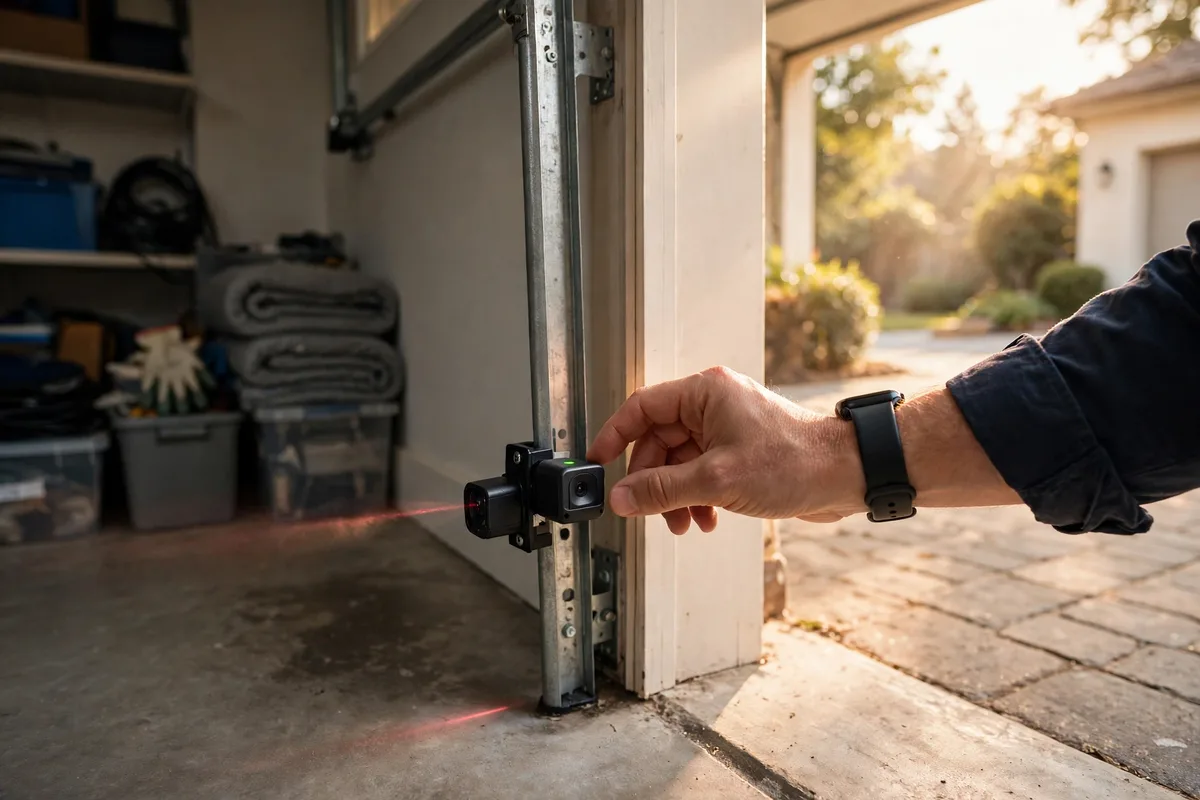
Every modern automatic garage door relies on a small pair of electronic eyes near the floor to keep people, pets and cars safe. Those garage door safety sensors are easy to ignore while they work, and deeply confusing when they do not: the door refuses to close, reverses for no obvious reason, or the opener light flashes in protest. This guide explains what the sensors do, how the photo-eye system works, the faults that crop up most often in UAE homes and the checks you can safely carry out yourself before calling a technician.
What Garage Door Safety Sensors Do
Safety sensors, often called photo eyes, sit on either side of the garage door opening, usually 10 to 15 centimetres above the floor. One side sends an invisible infrared beam across the opening and the other receives it. As long as the beam is unbroken, the opener knows the doorway is clear. If anything interrupts the beam while the door is closing (a child, a pet, a bicycle, the back of your car), the opener stops the door and reverses it to the fully open position.
This is not an optional extra. The sensors are the main protection against a heavy sectional or roller door closing on something that cannot move out of the way, and a door that closes with faulty sensors is a genuine hazard in a family villa. It is also why you should never tape over, unplug or deliberately bypass them, however annoying a temperamental sensor can be.
How the Photo-Eye System Works
The sending sensor has a small LED that projects the beam; the receiving sensor has a matching indicator light that stays lit while it can “see” its partner. Both units wire back to the opener motor unit, typically with thin low-voltage bell wire running along the wall and ceiling. Most brands use coloured indicator lights to show status: a steady light usually means the beam is aligned and received, while a flickering or dark receiving light means the beam is blocked, misaligned or not powered.
Because the whole system depends on two small brackets staying perfectly aimed at each other across the width of a door, tiny knocks matter. A bump from a pressure washer, a stored ladder or even a child’s football can tilt one sensor by a few millimetres, which is enough to break the circuit. If your door also shows other odd behaviour, our guide to a garage door opener that is not working covers the faults that start at the motor unit itself.
Signs Your Safety Sensors Need Attention
The classic symptom is a door that starts to close, then reverses and returns to open, often with the opener light flashing several times. A door that will only close while you hold the wall button down is another tell-tale sign: holding the button overrides the sensors, which tells you the opener itself suspects a sensor problem. Other clues include one sensor light being out or flickering, the door behaving differently at certain times of day, and the remote closing the door intermittently while the wall control works, a pattern also discussed in our troubleshooting guide for a garage door that is not closing.
Common Sensor Problems in UAE Homes
The local climate creates its own list of culprits. Fine dust settles on the sensor lenses and weakens the beam gradually, so a system that worked in spring can start sulking by late summer. Intense sunlight is another frequent cause: when low sun shines directly into the receiving sensor, it can overwhelm the infrared signal, which is why some doors fail only in the late afternoon. Heat can warp cheap plastic brackets over time, and the occasional shamal gust slamming the door can shift alignment, much like the knocks that can push a door towards the problems described in our guide to a garage door off its track. Finally, the thin sensor wires suffer in garages: they get pinched by stored items, chewed during pest visits, or corroded near coastal areas.
Troubleshooting Steps You Can Safely Try
Work through these in order; none of them involves touching springs, cables or the opener’s internals.
- Clean both lenses with a soft, dry or slightly damp cloth. Dust film is the most common cause of all.
- Check the indicator lights. Both should be lit and steady. If the receiving light is out or flickering, the beam is not getting through.
- Realign by hand. Loosen the bracket wing nut slightly, nudge the sensor until the receiving light goes solid, then tighten. Small movements make a big difference.
- Clear the doorway completely, including cobwebs and stored boxes near the sensors, and check nothing hangs into the beam’s path.
- Inspect the visible wiring for pinches, breaks or loose connections at the sensor terminals. If wires are damaged, stop and call a technician rather than splicing them yourself.
- Test the system properly afterwards. Close the door and wave a cardboard box through the beam; the door should reverse immediately. Also place a solid object in the doorway and confirm the door will not close onto it.
While you are working around the door, it is a good moment to run through the checks in our preventive garage door maintenance guide, since sensors, rollers and hinges all benefit from the same seasonal once-over.
When to Call a Garage Door Technician
If both lights stay dark, the wiring is damaged, the door still reverses after careful realignment, or the opener itself clicks and flashes without moving the door, the fault is beyond lens cleaning and needs a professional. Sensor pairs are not expensive parts, but they must match the opener brand and be wired and aligned correctly; a mismatched or badly fitted sensor is worse than the original fault. A technician will also test the door’s overall safety behaviour, including the force settings and the manual release, and can fold the visit into the wider security checks covered in our guide on how to secure your garage door from intruders. Look after your garage door safety sensors with a quick clean and alignment check every few months, and they will quietly do their job for years: keeping the heaviest moving object in your home safe for everyone who walks under it.
