A wall mounted garage door remote is one of the most practical upgrades you can make inside your garage. Instead of hunting for a handheld clicker in a drawer or a car, you walk in, press a button fixed to the wall, and the door moves. This guide explains what a wall mounted garage door remote is, where to place it, how to install and pair it, and how to fix the most common problems, so you can choose and use one with confidence.
If you are still deciding between control options, start with our overview of garage door remotes and the broader complete guide to garage door remotes, which explain how handheld remotes, keypads, and wall consoles fit together.
What Is a Wall Mounted Garage Door Remote?
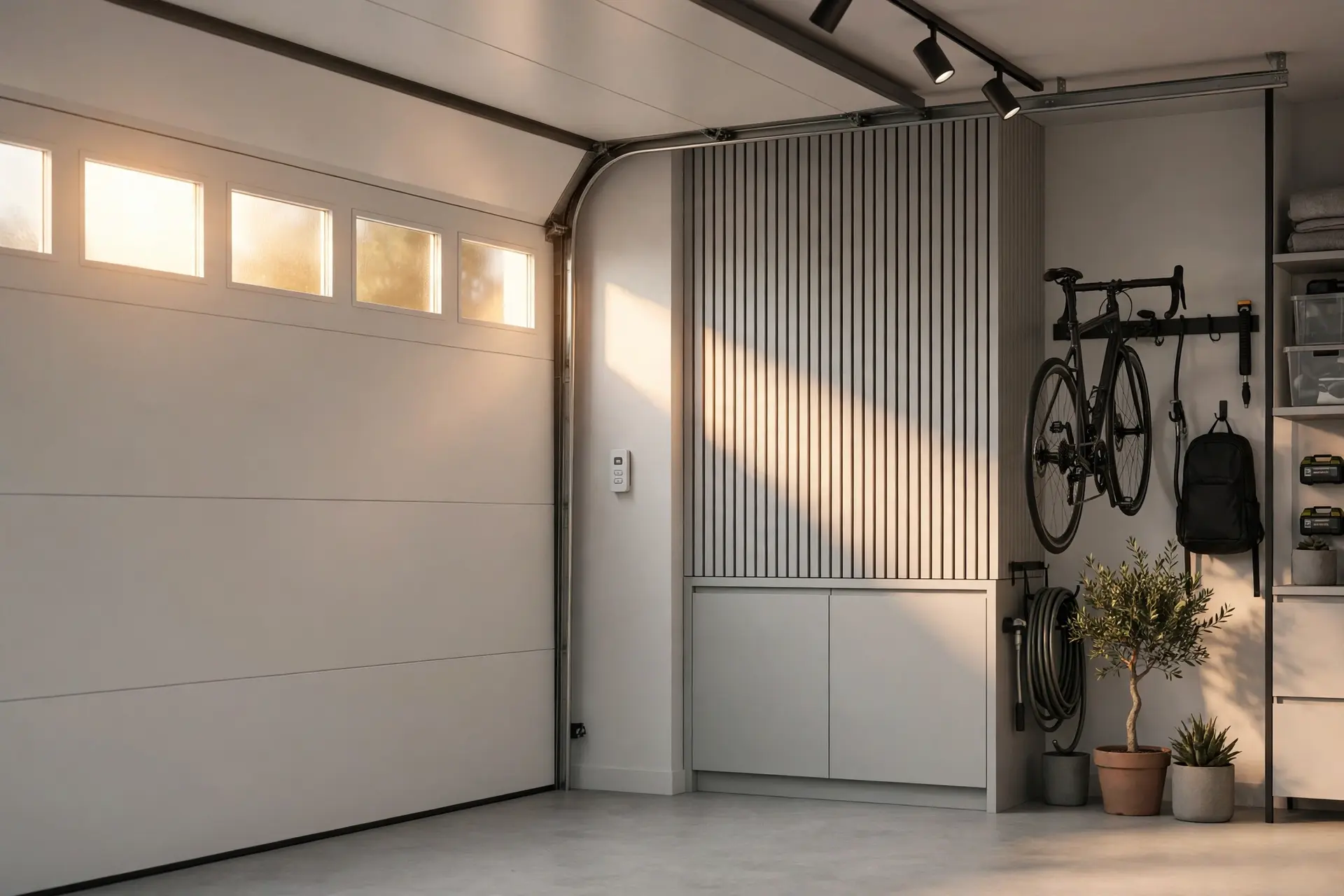
A wall mounted garage door remote, often called a wall console or wall control panel, is a fixed control unit screwed or clipped to the wall inside your garage, usually near the door that leads into your home. Wired versions connect to the opener motor with a low-voltage bell wire, while wireless versions run on a battery and communicate with the opener by radio signal, much like a handheld remote. Most models carry at least an open and close button, and many add a light button for the opener lamp and a lock or vacation button that disables handheld remotes.
The key difference from a handheld remote is permanence. A wall mounted garage door remote stays where you put it, so everyone in the household knows where the control is, and it cannot be left in a car that is away from home. That makes it especially useful for households where several people use the garage, for garages used as a workshop or laundry route, and for anyone who regularly enters through the garage rather than the front door.
Benefits of a Wall Mounted Garage Door Remote
The most obvious benefit is convenience. You do not need to carry anything, and you do not need to remember where a remote was last left. A wall control is also easy to use with full hands, since a large button is simpler to press than a small clicker, and it works even when your car remote battery has gone flat. For families, a fixed control at a sensible height keeps operation simple and predictable, and it removes the risk of a handheld remote being misplaced by children or visitors.
There is also a security angle. A wall console with a lock feature lets you disable outside remotes while you are away, which is a useful extra layer alongside the other measures in our guide on how to secure your garage door. And because a wired wall console draws power from the opener itself, it keeps working when handheld remote batteries die, which is one less thing to troubleshoot on a busy morning.
Choosing the Right Wall Mounted Garage Door Remote
Compatibility comes first. Garage door openers use different radio frequencies and coding systems, and a wall control made for one brand or model family may not work with another. Check your opener brand, model, and year, and match the wall console to that opener. If you are unsure, the opener manual or the label on the motor unit will usually list compatible accessories, and our guide to programming a garage door remote explains how opener brands differ in their pairing steps.
Next, decide between wired and wireless. A wired wall console is a good choice when your garage already has bell wire running from the opener to the wall, or when you are replacing an existing wired control in the same spot. A wireless wall-mounted unit suits garages without that wiring, rented homes where you want to avoid running cable, or spots far from the opener where running wire would be awkward. Battery-powered wireless units need a battery change from time to time, so factor that into your choice.
Finally, think about features you will actually use. A simple open and close button is enough for many households. A light button is handy if your garage is dark, a lock button is useful when travelling, and a motion-sensing panel that lights up as you approach is a nice touch in a garage used at night. More features mean more to learn, so pick the simplest unit that covers your daily routine.
Where to Place a Wall Mounted Garage Door Remote
Placement matters more than most people expect. Mount the control on the wall near the entry door into your home, at a height adults can reach comfortably but small children cannot easily reach on their own. Keep it in clear sight of the garage door itself, because you should always be able to see the door while it is moving, and never operate the door when you cannot see whether the path is clear.
Avoid mounting the control on a moving part, on the door itself, or anywhere the door or its tracks could strike it. Keep it away from damp spots, direct water spray, and places where tools or stored items could knock against it. If your garage has a side entry used more often than the internal door, that wall may be the better spot, as long as the door remains visible from it. Take a moment to stand at the planned spot and check the view of the door before you drill anything.
How to Install a Wall Mounted Garage Door Remote
For a wired wall console, start by switching off power to the opener at the wall socket for safety. If you are replacing an existing wired control, note which wire goes to which terminal before you disconnect anything, and take a photo for reference. Connect the new console to the same terminals, mount it firmly to the wall, restore power, and test the door while watching it travel fully in both directions. If the door does not respond, check that the wires are seated properly and that no wire insulation is trapped under a terminal screw.
For a wireless wall-mounted unit, installation is simpler: fit the battery, mount the bracket or adhesive plate in your chosen spot, and clip the unit in place. Pairing usually follows the same pattern as a handheld remote, which means pressing the learn button on the opener motor and then pressing the wall control button within the window described in your opener manual. If your opener has a learn button, our guide to the learn button on a garage door opener explains where to find it and how it works. Always test the door through a full open and close cycle after pairing, and test the safety reversal by placing a suitable obstruction in the door path as your manual describes.
If your garage has no suitable wiring and you are not comfortable working around the opener motor, or if the opener is old and its terminals are damaged, it is worth calling a professional rather than forcing a fit. A short visit to install the control correctly costs far less than damage to the opener board from a wiring mistake.
Troubleshooting a Wall Mounted Garage Door Remote
When a wall mounted garage door remote stops working, start with the simplest checks. For a wireless unit, replace the battery first, since a weak battery is the most common cause of intermittent operation. For a wired unit, check that the wires are secure at both the console and the opener, and that no wire has been pinched, cut, or chewed. Our guide to a garage door remote not working walks through the same checks for handheld remotes, and most of them apply here too.
If the door moves only part of the way, stops, or reverses, the problem is usually with the door or the opener rather than the wall control. Check for obstructions in the tracks, dirty or misaligned safety sensors near the floor, and a door that feels heavy or unbalanced when disconnected from the opener. Never force a door that is stuck or off its tracks, and never disconnect safety sensors to get the door moving. A door that reverses unexpectedly is protecting people and property, so find the cause before using it normally again.
Intermittent operation, where the control works sometimes and not others, often points to a weak battery, loose wiring, or radio interference from nearby electronics. Try fresh batteries, reseat the wires, and note whether the problem happens at particular times of day, which can help a technician trace interference. If the wall control works but a handheld remote does not, the handheld remote battery is the likely culprit, and our guide on how to change the battery in a garage door remote covers that job.
Wall Mounted Remote vs Handheld Remote vs Keypad
Each control type suits a different moment. A wall mounted garage door remote is best for everyday use inside the garage, because it is always there and always in the same place. A handheld remote is best in the car, where you want to open the door before you reach it. A keypad outside the garage is best for people who need access without a remote, such as family members on foot or a trusted visitor with a code, and our guide to the wireless garage door keypad explains that option in detail.
Most households end up using a combination: a wall console inside, a handheld remote in each car, and a keypad outside if needed. That combination covers the common routines without depending on any single device. If you add a smart opener later, the wall console still has a role, since it gives you a simple physical control that works even when your phone is charging or your home network is down.
Maintenance Tips for a Wall Mounted Garage Door Remote
Maintenance is light but worth doing. Wipe the console occasionally so buttons do not stick, check wireless batteries once or twice a year, and glance at wired connections when you service the door. Keep the area around the console clear so the button is easy to reach in a hurry. If the console feels loose on the wall, refix it before it pulls free and damages the wiring.
Look after the door itself too, since a wall control cannot fix a door that is stiff, noisy, or unbalanced. Regular attention to tracks, rollers, springs, and sensors keeps every control working smoothly, and our garage door maintenance guide sets out a sensible routine. Springs in particular are under high tension and should only be handled by a trained technician, so leave spring work out of your own maintenance list.
When to Call a Professional
Call a professional if the opener board shows signs of damage, if wiring is burnt or frayed, if the door is heavy, uneven, or off its tracks, or if the door reverses or refuses to close after you have checked for obstructions and sensor alignment. The same applies if a new wall console will not pair after you have followed the manual steps, since the opener receiver or logic board may need attention. A technician can confirm compatibility, fit the control safely, and check the door balance and safety systems in the same visit.
A wall mounted garage door remote is a small device, but it shapes how your garage feels every day. Choose a compatible unit, mount it where the door is visible and the button is easy to reach, pair it carefully, and keep the door itself in good order. Done that way, the control on the wall becomes the simplest and most reliable way in and out of your garage.
