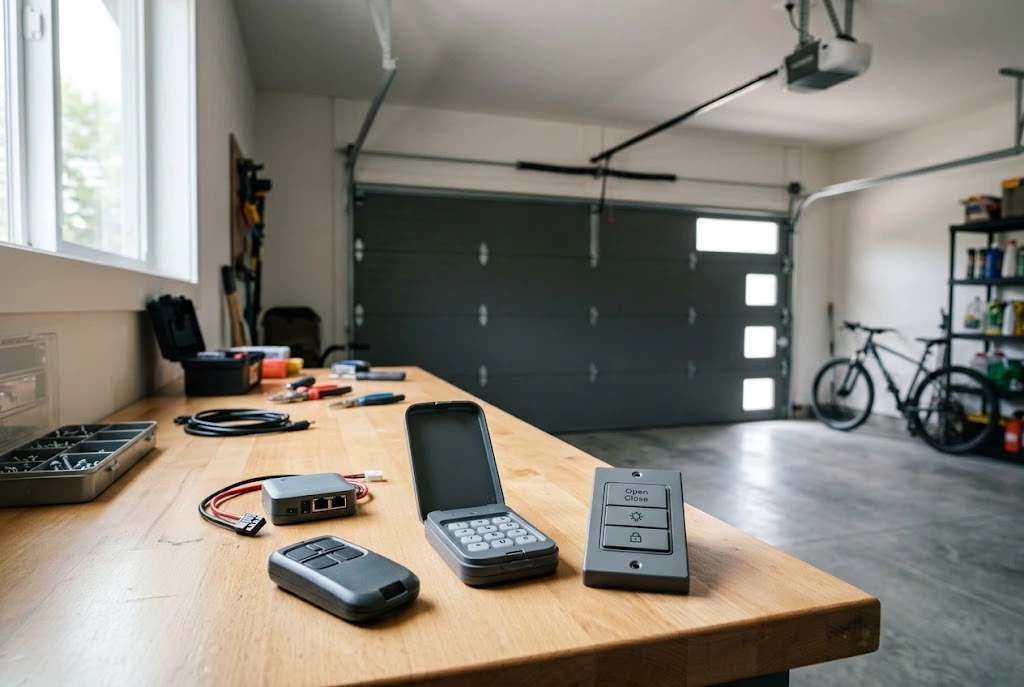
Garage door opener accessories make everyday access more convenient by allowing homeowners and businesses to control, secure, and manage their garage doors in different ways. From a garage door transmitter to a wireless keypad, the right accessories can improve usability, support access management, and help you get more from an existing opener without necessarily replacing the entire system.
However, not every accessory works with every opener. Before buying a garage door opener accessory, consider your opener model, receiver compatibility, security features, installation requirements, and daily usage. This guide explains the most useful accessory types, how they work, and what to check before choosing a replacement or upgrade.
What Are Garage Door Opener Accessories?
Garage door opener accessories are additional devices or components that support the operation, convenience, or access control of a garage door system. They may be supplied with an opener or purchased separately to replace damaged equipment, add another control method, or improve everyday operation.
Common examples include handheld transmitters, replacement remotes, wireless keypads, wall-mounted controls, and compatible motor or receiver components. Some accessories are designed for a specific opener brand, while others support selected models from multiple manufacturers.
The right choice depends on how you use your garage. A homeowner may want an extra remote for another vehicle, while a business may need several authorized transmitters or a keypad for controlled entry. In either case, compatibility should come before convenience or appearance.
Essential Garage Door Opener Accessories to Consider
1. Garage Door Transmitter
A garage door transmitter is a handheld or vehicle-mounted device that sends a wireless signal to a compatible garage door opener. It allows an authorized user to operate the door without using a wall control.
Transmitters are useful for households with multiple drivers, detached garages, and properties where convenient vehicle access is important. Depending on the model, a transmitter may support one door or multiple compatible channels.
Before buying a replacement, check the opener’s model number, supported radio frequency, and security technology. A remote that looks similar to your existing device may still be incompatible with the receiver.
If your current transmitter has stopped responding, review our guide to garage door remote troubleshooting before deciding whether replacement is necessary.
2. LiftMaster Garage Door Transmitter
A LiftMaster garage door transmitter can be a suitable option for an opener that supports the particular transmitter model. LiftMaster equipment comes in different generations, so compatibility should be verified rather than assumed from the brand name.
Check the opener’s identification label and consult the manufacturer’s product documentation. The supported transmitter, programming procedure, and security protocol may vary according to the installed equipment.
For official product information, consult the LiftMaster website. If you are replacing an existing remote, our garage door opener remote compatibility guide explains the key details to compare before purchasing.
3. Garage Door Opener with Keypad
A garage door opener with keypad functionality provides an alternative to carrying a handheld remote. An authorized user enters a programmed code using a compatible keypad to operate the door.
This option can be convenient for households where family members arrive separately or where an authorized person needs access without carrying a remote. A keypad may also be useful when a remote battery is depleted, provided the keypad has its own power and the opener is functioning correctly.
Keypads are not universally interchangeable. Confirm the supported opener models, wireless technology, and programming requirements before purchasing one.
4. Garage Door Opener and Keypad Combinations
A garage door opener and keypad can work together to provide more than one method of authorized access. Handheld remotes offer convenience for drivers, while a compatible keypad supports entry using a code.
When considering this combination, think about who needs access and how permissions will be managed. For example, a household may assign access to family members, while a small business may need a documented process for changing codes when access requirements change.
For more information about keypad options, see our guide to the garage door keypad and our overview of the universal garage door keypad.
5. Wired Garage Door Opener Controls
A wired garage door opener control typically connects to a compatible opener through a physical cable. Unlike a wireless transmitter, it does not depend on a handheld radio signal to communicate with the opener.
Wall-mounted controls are useful for operating the door from inside a garage or another designated location. Depending on the equipment, a control may provide basic door operation or additional functions supported by the opener.
Before installing a wired control, confirm the opener’s terminal and control requirements. Do not assume that any wall button or wired accessory can be connected to any motor. Incorrect wiring may damage equipment or interfere with safe operation.
6. Motorised Garage Door Opener Components
A motorised garage door opener relies on compatible electrical and mechanical components to move the door. Depending on the system, relevant components may include a motor unit, drive mechanism, receiver, control board, and safety-related devices.
When a component fails, identify the actual cause before purchasing a replacement. A door that does not move may have a power, control, receiver, or mechanical problem rather than a defective motor.
Our guide to the garage door motor explains the role of the motor, while garage door components provides a broader overview of the parts that make up a garage door system.
How to Choose the Right Garage Door Opener Accessories
The best accessories are those that work with your existing equipment and meet your access needs. Use the following checks before making a purchase.
Check the Opener Model and Compatibility
Find the model number on the opener’s identification label. If you are purchasing a remote or keypad, compare that information with the accessory manufacturer’s compatibility list.
For wireless devices, check the supported frequency and security technology. For wired controls and replacement components, verify the electrical and connection requirements specified for the opener.
Identify Your Main Purpose
Choose an accessory based on the problem you want to solve. A replacement transmitter addresses a lost or defective remote, while a keypad provides another access method. A wired wall control may be more suitable when you want a fixed control point inside the garage.
If the door itself is operating poorly, buying another remote may not help. Check the symptoms first and determine whether the issue involves the accessory, opener, or mechanical parts.
Consider Security and Access Management
Garage door accessories can affect who is able to enter your property. Choose devices with security features appropriate to the opener and keep access credentials under control.
If a remote is lost or stolen, follow the manufacturer’s procedure for removing unauthorized devices where supported. If a keypad code is shared with someone who no longer requires access, change it according to the equipment instructions.
Review Installation Requirements
Some accessories can be programmed by following the manufacturer’s instructions, while others require wiring or technical adjustments. Read the installation manual before beginning work and make sure you understand any necessary precautions.
Electrical work, unfamiliar receiver connections, and adjustments to powered equipment may require a qualified technician. Avoid bypassing safety features to make an accessory work.
How to Maintain Garage Door Opener Accessories
Regular checks can help keep remotes, keypads, and controls in good working condition. Store handheld transmitters away from moisture and excessive heat, avoid dropping them, and replace batteries with the type specified by the manufacturer.
Keep keypad buttons clean and inspect accessory housings for visible damage. If a remote works intermittently, test its battery and check whether another compatible remote operates the opener correctly.
It is also important to maintain the door and opener rather than focusing only on the accessories. Follow an appropriate garage door maintenance routine and arrange professional service if the door moves unevenly, makes unusual noises, or shows visible mechanical damage.
Common Problems with Garage Door Opener Accessories
The Remote Does Not Work
Check the battery, confirm compatibility, and inspect the remote for damaged buttons. If the problem continues, verify that the opener has power and consult the correct programming instructions.
For additional help, read our article on why a garage door remote may stop working.
The Keypad Will Not Operate the Door
A keypad problem may involve incorrect programming, a weak battery, an incompatible device, or an issue with the opener. Follow the keypad’s model-specific instructions and check that the opener supports the accessory.
Do not repeatedly reset the opener without checking the manual, as some reset procedures can remove existing device settings.
The Opener Motor Runs but the Door Does Not Move Correctly
If the motor operates but the door fails to move as expected, the problem may involve the drive mechanism or another mechanical component. A remote or keypad replacement is unlikely to resolve a mechanical fault.
Stop operating the door if it appears damaged, moves unevenly, or has a broken spring or cable. These components can be dangerous to handle without appropriate training.
Frequently Asked Questions
What are the most common garage door opener accessories?
Common accessories include handheld transmitters, replacement remotes, wireless keypads, wall-mounted controls, and compatible replacement components. The appropriate choice depends on your opener and access requirements.
Can I use a universal garage door transmitter?
Yes, if the transmitter explicitly supports your opener’s model, frequency, and security technology. Universal devices do not work with every garage door system, so verify compatibility before purchasing.
Can I add a keypad to my existing garage door opener?
In many cases, a compatible keypad can be added to an existing opener. Check the manufacturer’s supported-device list and follow the programming instructions for your specific equipment.
Are wired controls better than wireless remotes?
Neither option is universally better. Wired controls provide a fixed operating point, while wireless remotes allow convenient operation from a suitable distance. Some properties benefit from having both.
Should I replace the motor if the remote stops working?
Not necessarily. Start by checking the remote battery, programming, and compatibility. If other controls also fail, investigate the opener and receiver before deciding whether a component needs replacement.
Final Thoughts
Garage door opener accessories can make a garage more convenient and help you manage access according to your household or business needs. A suitable transmitter, compatible keypad, wired control, or replacement component can address a specific requirement without automatically requiring a complete opener replacement.
Before purchasing any accessory, identify your existing equipment, verify compatibility, and review the installation instructions. Maintain your remotes and controls regularly, manage access securely, and seek professional help when the problem involves wiring, the motor, or the door’s mechanical and safety components.
